

Table of Contents
- The Misconception About Indian Breads
- North India: Wheat, Fire, and the Tandoor
- The West and Center: Mobility and Everyday Flatbreads
- The South: Rice, Fermentation, and Soft Textures
- Technique Over Recipe: Why Method Defines Bread
- Experiencing Indian Breads at The Crossing Nice
The Misconception About Indian Breads
Indian breads are often reduced to a short list—naan, roti, maybe paratha. The reality is far more precise and regional. Indian breads evolved not as interchangeable sides, but as responses to geography, agriculture, and cooking infrastructure.
At its core, Indian bread is about three variables: grain, heat, and time. Wheat dominates in the north, rice in the south, millet in arid zones. Cooking methods—from open flame to clay ovens to griddles—shape texture as much as ingredients do. What emerges is not one category, but a network of breads designed to complement specific dishes, climates, and rhythms of eating.
Understanding Indian breads begins with this shift: they are not just accompaniments—they are engineered for context.
North India: Wheat, Fire, and the Tandoor
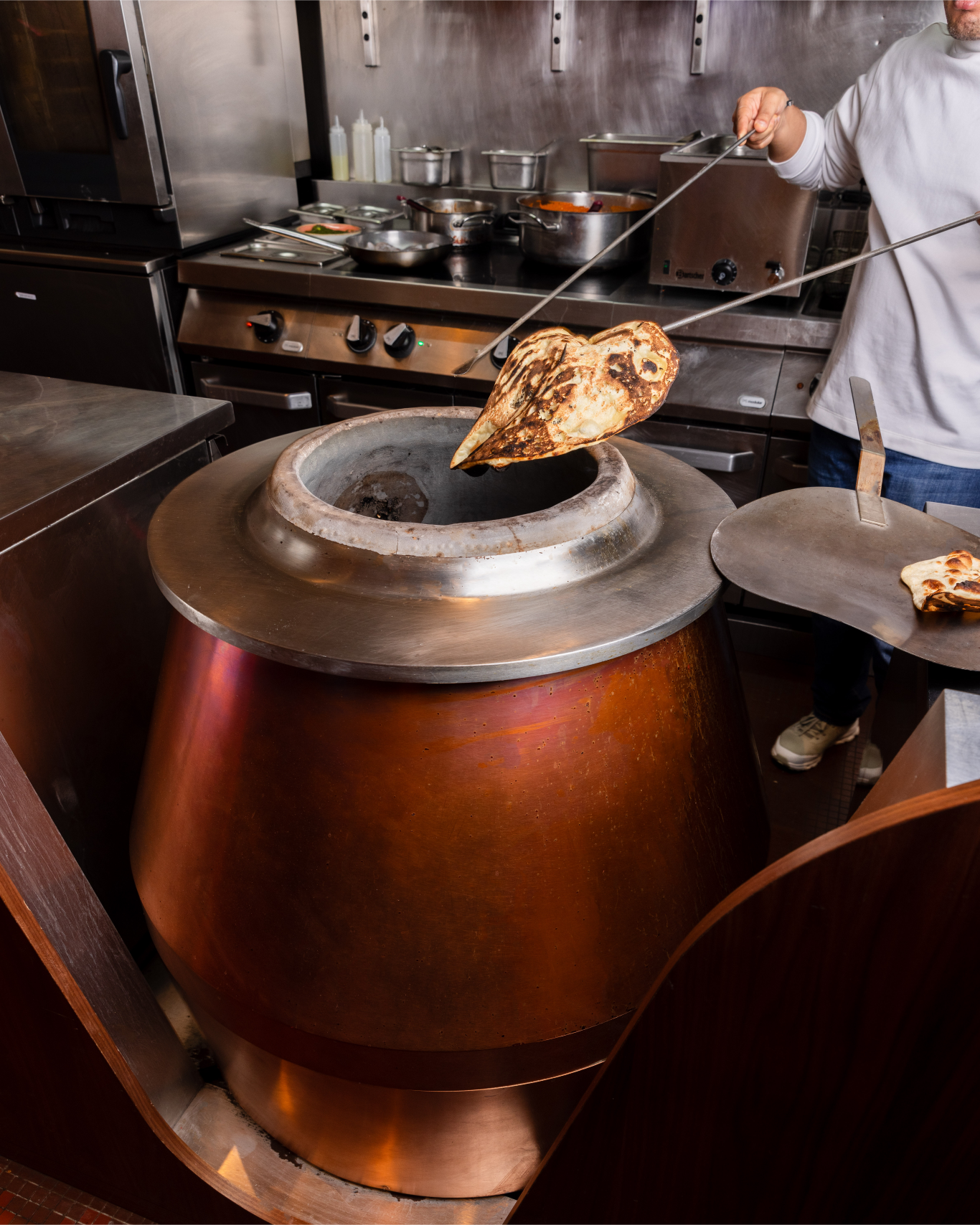
Northern India’s bread culture is defined by wheat and high-heat cooking. The introduction and refinement of the tandoor—a cylindrical clay oven—transformed how breads were made and consumed.
Naan is the most globally recognized example, but its significance lies in technique rather than popularity. Made with refined flour and often enriched, naan relies on intense heat to achieve its characteristic blistered exterior and soft interior. It was historically associated with communal ovens and professional kitchens rather than daily home cooking.
Alongside naan, you find roti and phulka—simpler, unleavened breads cooked on a flat griddle and finished over open flame. These breads are lighter, faster, and designed for everyday meals.
At The Crossing Nice, this distinction matters. Breads are not chosen for familiarity but for how they interact with dishes—whether it’s absorbing a slow-braised Railway Lamb Curry or balancing the richness of butter-based gravies.
The West and Center: Mobility and Everyday Flatbreads
In western and central India, breads evolved for portability and durability. Regions like Rajasthan and Gujarat, shaped by arid climates, favored grains like millet (bajra) and sorghum (jowar).
These flours produce denser, more rustic breads—less elastic than wheat but deeply functional. Thepla, bhakri, and other regional variations were designed to last longer, travel well, and sustain labor-intensive lifestyles.
What’s notable here is restraint. These breads are rarely rich or layered; instead, they emphasize practicality and pairing. They are eaten with pickles, yogurt, or simple vegetable preparations, forming complete meals without excess.
This philosophy aligns closely with The Crossing’s approach—editing rather than embellishing, allowing technique and ingredient to define the experience rather than overcomplication.
The South: Rice, Fermentation, and Soft Textures
Southern India introduces a completely different logic. Here, rice replaces wheat, and fermentation becomes central.
Breads like appam and dosa are not “breads” in the Western sense, but they serve a similar structural role. Made from fermented rice batters, they offer softness, tang, and digestibility—qualities suited to humid climates and lighter, coconut-based curries.
Appam, with its lacy edges and soft center, is designed to hold liquid without collapsing. Dosa, thinner and crisp, provides contrast and texture. These are not incidental qualities—they are deliberate outcomes of fermentation and heat control.
This regional shift highlights a broader truth: Indian breads are not defined by shape, but by function. Each one is built to work with specific ingredients, climates, and cooking traditions.

Technique Over Recipe: Why Method Defines Bread
Across all regions, one principle remains constant: technique matters more than complexity.
The difference between a good bread and a forgettable one often comes down to heat management, timing, and repetition. Whether it’s the blister of a tandoor-fired naan or the softness of a fermented appam, mastery is rarely visible—it’s felt in texture and balance.
At The Crossing Indian Bistro in Nice, this philosophy is central. Bread is not treated as a side but as an integral part of the meal’s architecture. Each preparation reflects a controlled approach—measured, intentional, and designed to support rather than overshadow the dish.
Experiencing Indian Breads at The Crossing Nice
For diners exploring Indian cuisine in Nice, understanding breads transforms the experience. Instead of defaulting to familiarity, you begin to choose based on interaction—how a naan complements a curry, how a lighter bread balances spice, how texture changes the pace of a meal.
At The Crossing Nice, located in CAP3000 overlooking the Mediterranean, this approach is embedded in the menu. The breads—whether classic naan or layered paratha—are crafted to align with the restaurant’s broader philosophy: clarity, restraint, and respect for tradition without excess.
Indian breads, in this context, are not just heritage items. They are living techniques—adapted, refined, and still evolving, one table at a time.
Conclusion
Indian breads evolved not as a uniform tradition, but as a precise response to land, climate, and culture. From the high heat of northern tandoors to the fermented softness of southern kitchens, each bread reflects a system of thought rather than a fixed recipe.
To understand them is to understand Indian cuisine itself: diverse, adaptive, and deeply intentional. And in places like The Crossing Nice, that understanding becomes something you can taste—quietly, and with clarity.


