
Table of Contents
- Why Storytelling Matters in Indian Dining
- Indian Cuisine as a Living Narrative
- Translating India, Not Recreating It
- How Dishes Carry Stories
- The Structure of a Meal as a Narrative
- Memory, Movement, and Flavour
- The Crossing: Where Story Becomes Experience
Why Storytelling Matters in Indian Dining
Flavour is often treated as a technical outcome—ingredients combined, heat applied, seasoning adjusted. But in Indian cuisine, flavour is rarely isolated from context. It is shaped by memory, movement, and meaning.
This is where storytelling becomes essential. Not as decoration, but as structure. It explains why dishes exist, how they evolved, and what they are meant to evoke.
At The Crossing in Nice, storytelling is not presented separately from the food. It is embedded within it—guiding how dishes are conceived, prepared, and experienced.

Indian Cuisine as a Living Narrative
Indian food is not a fixed system. It has always evolved through migration, trade, and cultural exchange.
Recipes travelled across regions, adapting to new ingredients and audiences while retaining their identity. This constant movement turned cuisine into a form of storytelling—each dish carrying traces of where it has been. From railway platforms to coastal kitchens, Indian food developed not through uniformity, but through coexistence.
Understanding this makes the cuisine more accessible. It shifts the focus from decoding complexity to recognising continuity.
Translating India, Not Recreating It
A key idea behind The Crossing is that Indian cuisine should not be replicated rigidly outside India—it should be translated.
Chef Ankur’s philosophy reflects this directly. The goal is not to present a nostalgic or exaggerated version of Indian food, but to express its logic in a way that feels natural in a new context. This approach influences flavour itself. Spices are used with restraint, techniques are emphasized over excess, and dishes are edited to highlight their essential structure.
The result is food that feels both authentic and immediate—grounded in tradition, but not bound by it.

How Dishes Carry Stories
At The Crossing, individual dishes are not isolated creations. They are part of a larger narrative shaped by movement and memory.
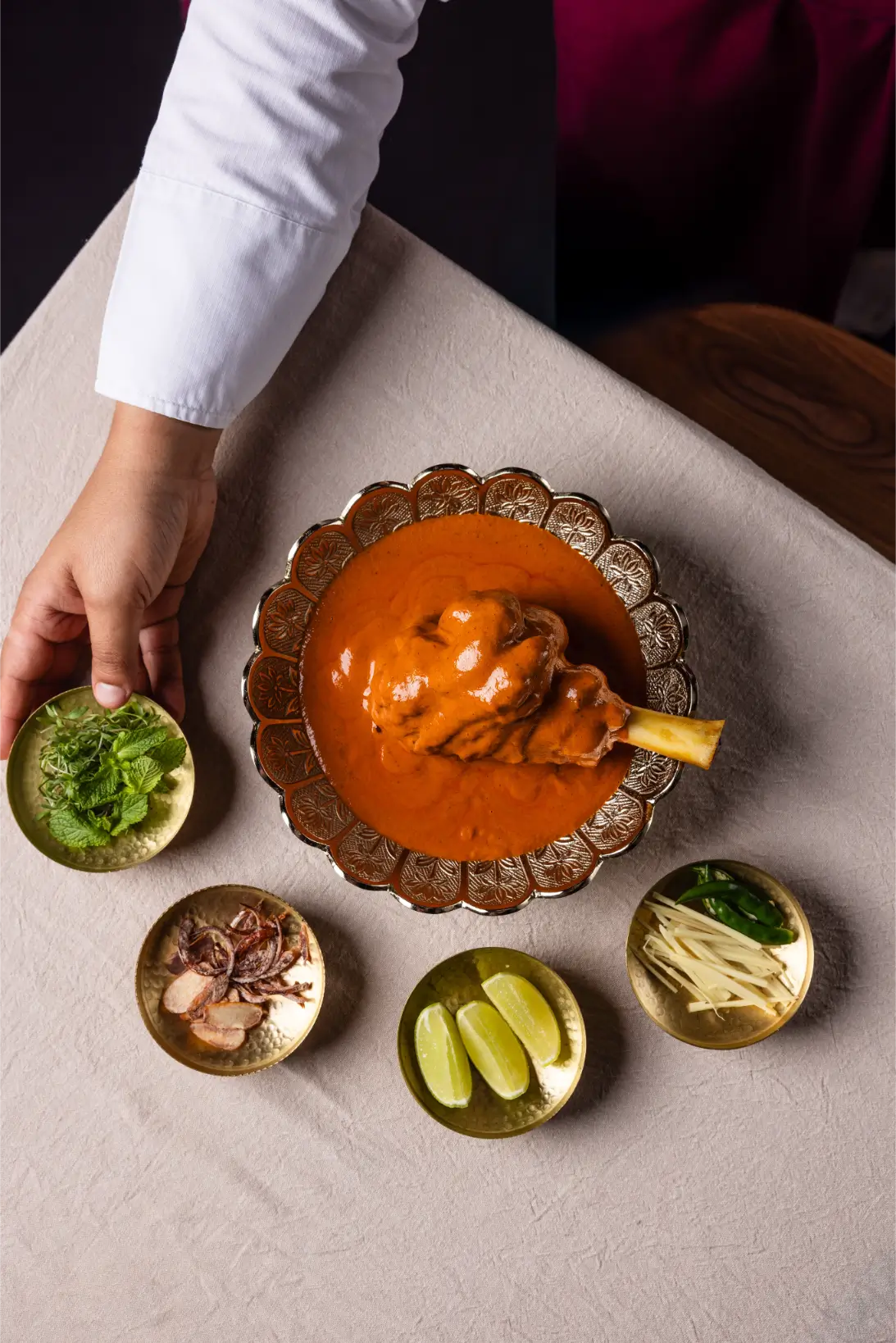
The Crossing Chaat Bowl, for example, reflects the layered, textural logic of Indian street food—designed to be immediate, expressive, and balanced. The Railway Lamb Curry carries a different story. Slow-braised and deeply developed, it reflects journeys across India’s rail networks, where food evolved through repetition and necessity.
Even dishes like biryani or dal are not just recipes—they are accumulations of technique, time, and regional influence.
Each plate becomes a fragment of a larger story, rather than a standalone statement.

The Structure of a Meal as a Narrative
Storytelling at The Crossing is not limited to individual dishes—it extends to how the meal unfolds.
A typical progression begins with lighter, textural plates, moves into grilled dishes shaped by fire, and settles into slow-cooked curries before concluding with something calm and balanced. This sequence mirrors the rhythm of Indian dining. It is not arbitrary; it is designed to build flavour gradually, allowing each course to prepare for the next.
In this sense, the meal itself becomes a narrative—one that develops over time rather than arriving fully formed.
Memory, Movement, and Flavour
Much of what defines Indian cuisine comes from movement—of people, ingredients, and ideas.
At The Crossing, this idea is central. The restaurant draws inspiration from railway crossings, where journeys intersect and stories are exchanged. These moments of pause—where people share food briefly before continuing on—shape how flavour is understood. It becomes something shared, remembered, and carried forward.
Ingredients themselves reflect this movement. Spices, grains, and techniques have travelled across regions, creating a cuisine that is both diverse and interconnected.
The Crossing: Where Story Becomes Experience
Located at CAP3000 in Nice, The Crossing Indian Bistro brings these ideas into a contemporary dining setting.
The restaurant is built around the concept of intersection—of cultures, journeys, and flavours. Every element, from the menu to the space, reflects this philosophy. Rather than presenting Indian cuisine as static or ornamental, it offers it as something lived and evolving. A system of thought as much as a collection of dishes.
For guests, this creates an experience that feels intuitive. The food makes sense—not because it is simplified, but because its story is clear.
Conclusion
Storytelling in Indian dining is not about explanation—it is about coherence.
It connects ingredients to technique, dishes to memory, and meals to movement. It turns flavour into something that can be understood, not just tasted.
At The Crossing, this connection is what defines the experience. Every dish, every sequence, every detail contributes to a larger narrative—one where Indian cuisine is not just served, but translated into something that belongs, here and now.


