
Table of Contents
- The Crossing Nice Story: Chef Ankur’s India–France Journey
- India, translated
- The discipline of leaving things out
- A room intended as a pause
- The story continues in Nice
The Crossing Nice Story: Chef Ankur’s India–France Journey
At an Indian railway crossing, everything pauses. Gates lower; bicycles, rickshaws and cars gather; a train passes with a brief view into hundreds of other journeys. Then the road opens and life moves again.
That small interruption gave The Crossing its name. Chef Ankur Chakraborty’s father worked for Indian Railways, so trains were part of his childhood rather than a borrowed romantic image. Journeys across India exposed him to changing landscapes, languages and meals. Food was never fixed. It travelled with people and altered as it went.
Years later, this became the thought at the centre of The Crossing Indian Bistro.

India, translated
“I didn’t open an Indian restaurant in France to recreate India,” Chef Ankur says. “I opened it to translate India.”
The distinction matters. He had seen Indian food outside the country reduced to a familiar set of rich curries, ornate rooms and an idea of nostalgia that left little space for regional movement. His experience of India was more fluid. It held coexistence: old technique and present-day life, street snacks and patient home cooking, one region borrowing from another without becoming the same.
The Crossing was built to express this livelier picture. It began in France at Galeries Lafayette Paris Haussmann in 2023. Nice followed, but not as a carbon copy of Paris. The Crossing Nice sits at CAP3000 on the Mediterranean-facing beach level, with the airport nearby and trains still part of the route. The location gives the railway idea a new setting: arrivals, departures and a meal that creates a pause between them.
The discipline of leaving things out
Chef Ankur has spent more than two decades in the restaurant industry, yet the principle he returns to is restraint. “Nothing goes on the plate without intention. Technique matters more than complexity. Time is respected,” he explains. “We do not cook to impress. We cook to earn trust.”
This is not minimalism for appearance’s sake. Indian cooking can ask a great deal of a spice before it asks for a great number of spices. Heat changes mustard seed; time softens onion; a tandoor leaves flavour that cannot be drawn on later as decoration. The kitchen’s task is to understand those changes and stop at the right moment.
The current Nice à la carte menu makes the philosophy tangible. The Crossing Chaat Bowl has the energy of Indian street food, but white-lentil dumpling, shiso crisp, chickpea and chutneys retain their individual voices. Paatra ni Fish Macchi steams sea bass and green herb masala inside banana leaf. In Railway Lamb Curry, the lamb shank is slow-braised; smoked rogani laal maas supplies depth without disguising the meat.
That last dish is personal. Its name carries Chef Ankur’s railway memories, while its method respects something less sentimental: the time a tough cut needs before it becomes tender. Memory sets the direction. Technique gets the dish there.
A room intended as a pause
The Nice restaurant does not try to reproduce a palace or a railway carriage. Chef Ankur describes the soul of The Crossing as “quiet confidence rather than spectacle.” Warmth is meant to come through intention—how guests are received, how a table is paced, how comfortably different appetites can eat together.
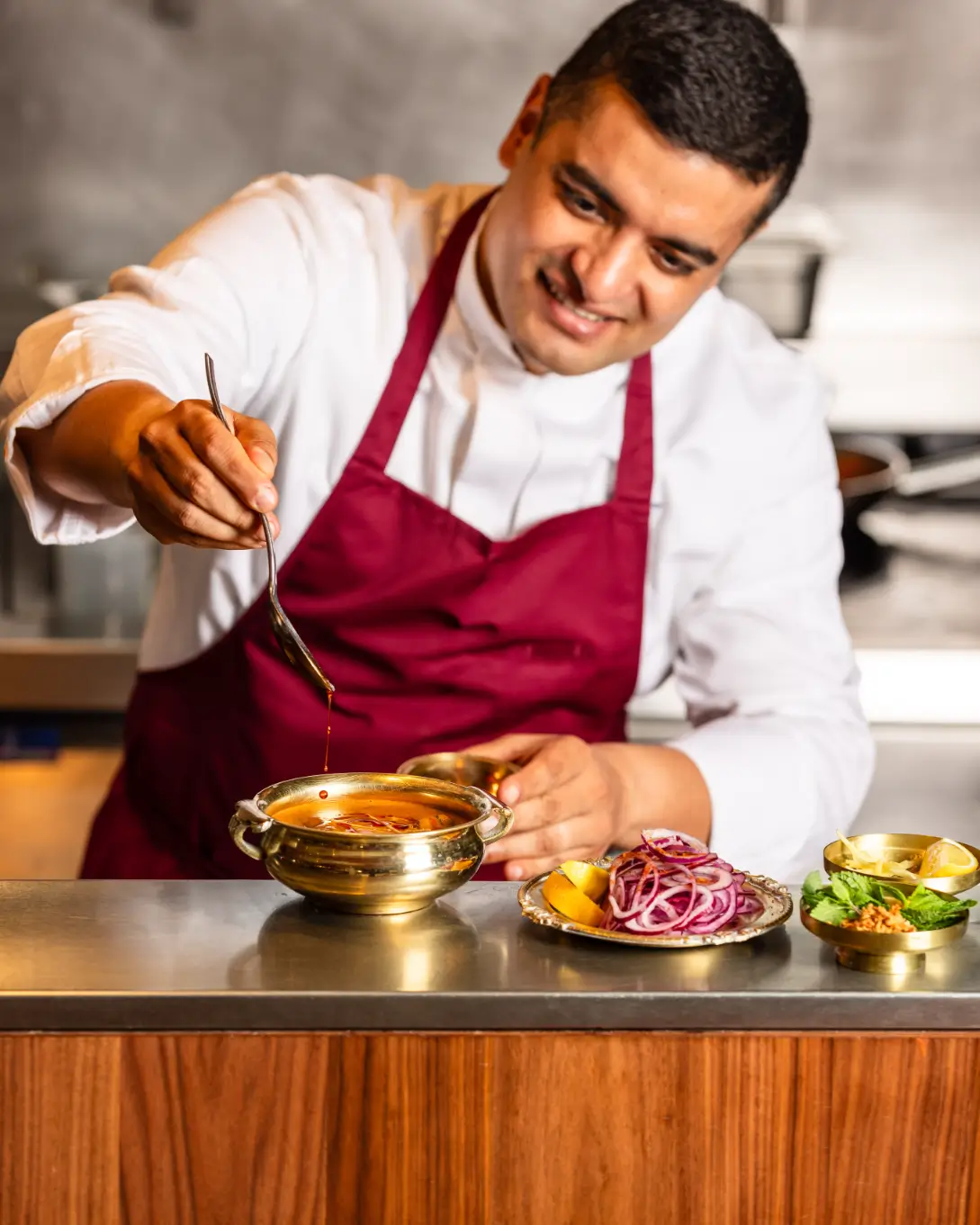
Even the objects support that thought. The brass tableware was handcrafted by Parul Handicraft in Moradabad, a city with a long metalworking tradition; individual pieces take close to twenty days to make. Ingredients including Tellicherry pepper, Kashmiri saffron and cardamom from the Western Ghats bring other places into the room more quietly. Their provenance has meaning only when the kitchen knows what to do with them.
Outside, there is the particular light of the Côte d’Azur and, in season, a terrace facing the sea. Inside, the food is paced in the Indian manner: several things in conversation, passed and shared rather than sealed into rigid courses. A guest can recognise Butter Chicken or Chicken Tikka Masala, then move towards Alleppey Prawns Curry, banana-leaf fish or a chaat they have not tried before.
Chef Ankur imagines a guest who eats well regularly and returns because trust has replaced novelty. French diners, he says, are often surprised by how light the food can feel. That reaction may be the surest sign the translation is working. The food is recognisably Indian, but it is not performing heaviness as proof of authenticity.
The story continues in Nice
The Crossing Indian Bistro Nice is not the final destination of a tidy journey. It is one more crossing point: India and France, memory and editing, railway motion and a table beside the Mediterranean. The story remains open because the food is allowed to remain in motion.
Visit the The Crossing Nice location page for opening hours and travel details. Walk-ins are welcome, though weekends and holidays can fill quickly; guests with a fixed date can reserve a table at The Crossing Nice.
The name began with a pause on the road. At The Crossing CAP3000, the same idea survives in a different form: sit down, let the journey wait, and give the food your attention.


