

Table of Contents
- Introduction: Why Nice Has Become a Hub for Global Dining Excellence
- The Rise of Indian Cuisine on the French Riviera
- The Crossing Nice: A Dining Destination Inside CAP3000
- How The Crossing Blends Indian Heritage With Riviera Sophistication
- Signature Culinary Experiences You Should Not Miss
- Dining by the Mediterranean: What Makes the Nice Location Unique
- Why Tourists and Locals Choose The Crossing for Indian Dining
- Final Thoughts: A Culinary Journey Rooted in Culture and Coastline
Why Railway Food Culture Still Matters Today
Indian railway food culture is best understood not simply as a cuisine, but as a reflection of how India itself has evolved. In Bharat Ek Khoj (The Discovery of India), Pt. Jawaharlal Nehru describes India as a civilisation shaped by movement, exchange, and continuity rather than isolation. Food, much like culture, followed people as they travelled.
Railway meals were never meant to impress. They emerged from necessity, from feeding people moving long distances across a vast and diverse land. In doing so, they became shared reference points across regions, languages, and communities. A traveller might forget the station name, but not the taste of a curry eaten midway through a journey.
What gives railway food its relevance today is its democratic nature. These dishes were neither elite nor regionally exclusive. They were practical, familiar, and emotionally grounding. This understanding sits at the core of Chef Ankur Chakraborty’s philosophy, that food gains meaning not from complexity alone, but from the role it plays in people’s lives.
In Nice, a city that values culture and authenticity, railway food culture resonates as more than nostalgia. At The Crossing, it is treated as a living tradition that continues to evolve with each journey.
A Brief History of India’s Railway Culinary Identity
The Indian Railways, established in the mid-nineteenth century, did far more than connect cities. They accelerated cultural exchange on a scale previously unknown. As Nehru reflects in The Discovery of India, India’s unity was never about sameness, but about connection. The railways made that connection tangible.
From a culinary perspective, trains required food to adapt. Long journeys demanded meals that could withstand time, heat, and travel. Food historian K. T. Achaya observed that Indian cooking had long relied on slow cooking, spice layering, and the use of fats for preservation. Railway food did not invent these techniques; it applied them intelligently to new circumstances.
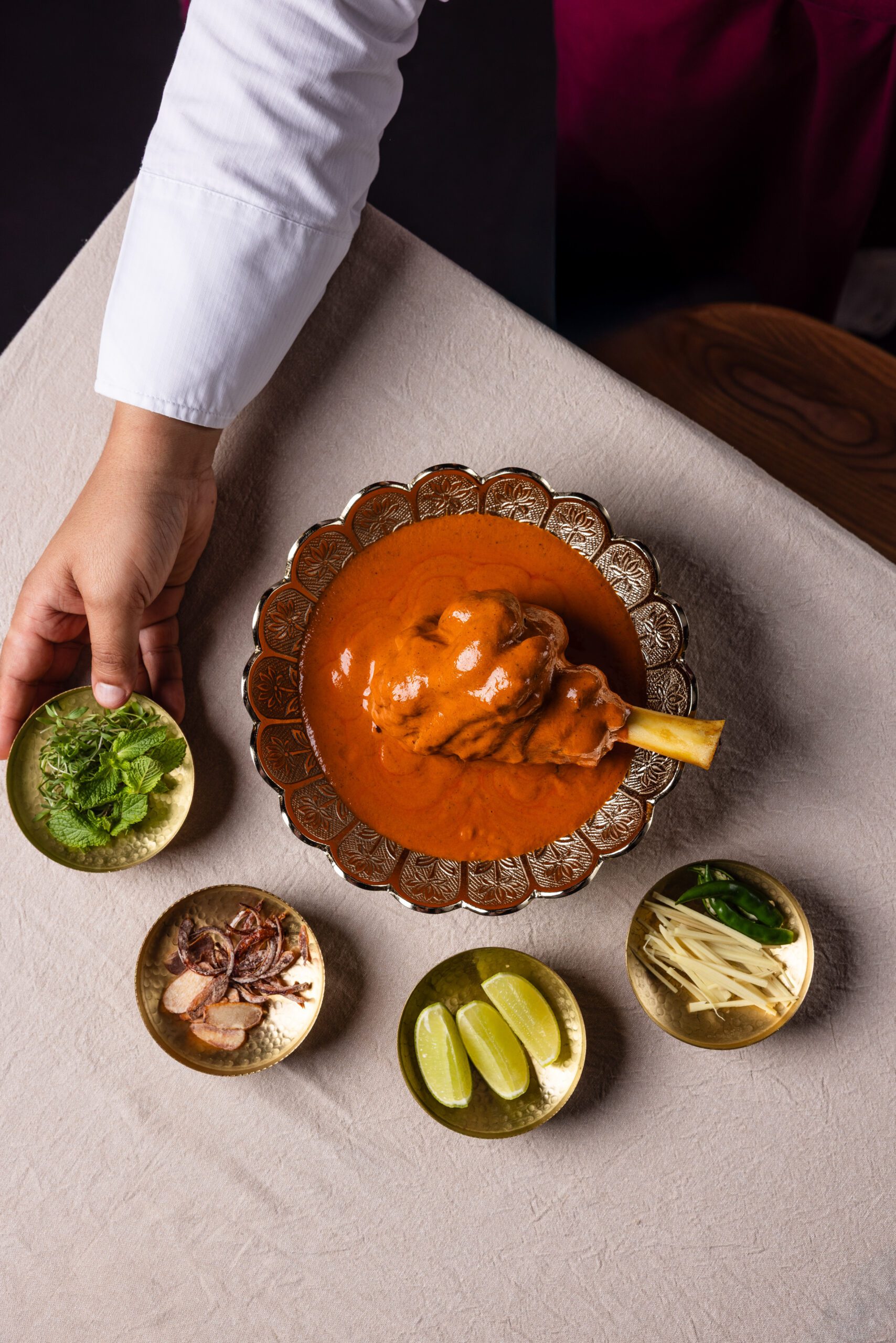
Platform vendors and railway kitchens popularised dishes that were robust and transport-friendly. Lentil stews, rice-based meals, spiced meats, cutlets, and chaats travelled far beyond their regional origins. Dishes such as Railway Lamb Curryemerged as practical hybrids, British-style stews interpreted through Indian spices, cooked slowly and meant to be eaten hours later without losing depth.
Chef Ankur Chakraborty often speaks of this period as one where Indian cuisine learned to be adaptive without losing its soul, a lesson that continues to inform the way food is approached at The Crossing.
How Railway Cuisine Reflects India’s Cultural Landscape
Railway cuisine reflects India’s cultural landscape because it is shaped by adaptation rather than purity. As food historian K. T. Achaya noted, Indian food history is cumulative, evolving through migration, exchange, and necessity rather than rigid regional boundaries. Railway food offers a clear expression of this evolution in motion.
Families with long-standing ties to the Indian Railways often experienced food as an integral part of travel, where meals were prepared in advance, shared during long journeys, and compared across regions. Differences in climate, water, and local produce subtly influenced taste, reinforcing the idea that Indian cuisine changes gradually across geography rather than abruptly at borders.
From a practical standpoint, ingredients used in railway food were selected for resilience as much as flavour. Dried spices replaced fresh aromatics because they travelled well. Curries were cooked longer to deepen flavour and stability. Rice, lentils, and slow-braised meats became staples because they retained character over time and distance.
Platform foods such as samosas, vada pav, and spiced nuts became icons because they suited the rhythm of railway life. They could be eaten quickly, standing, and without ceremony, reflecting the transient, communal environment of stations where travellers and vendors briefly intersected.
Railway cuisine, in this sense, represents India in motion, a shared culinary language formed through geography, migration, and everyday practicality. It is not tied to one region or tradition, but to the lived experience of travel itself, which is why it continues to resonate with modern diners seeking food rooted in authenticity and context.

The Crossing’s Railway-Inspired Philosophy in Nice
The philosophy behind The Crossing draws directly from this understanding of Indian food history. For Chef Ankur Chakraborty, it is also deeply personal. Growing up travelling with his father, who worked for the Indian Railways, meant that stations, pauses, and shared meals became part of how food was understood, not as performance, but as companionship.
Bringing this philosophy to Nice is not about recreating railway dishes exactly as they once were. It is about respecting their logic, food that is grounded, generous, and thoughtful. Dishes that hold their integrity without excess. Flavours that feel familiar, even when encountered far from home.
The French Riviera values refinement, but it also respects clarity and restraint. At The Crossing, railway-inspired cuisine is elevated through technique and presentation, not altered in spirit. The result is food that carries memory without sentimentality and tradition without heaviness.
Much like a train stopping briefly at a station, The Crossing offers a pause, a moment of connection, before the journey continues.
Chef Ankur Chakraborty, writings and reflections on Indian food and travel
Translating Heritage to the Riviera: Why These Recipes Belong in Nice
Nice is a city celebrated for its Mediterranean coastline, artistic spirit, and appreciation of culinary craftsmanship. Visitors come seeking experiences that blend culture, beauty, and gastronomy. In this environment, railway-inspired Indian cuisine becomes not just relevant but uniquely fitting. The comfort and warmth embedded in these dishes echo the emotions many associate with travel—moments of anticipation, longing, discovery, and nostalgia. By presenting these recipes in a refined yet heartfelt way, The Crossing offers guests in Nice a culinary journey that mirrors the very ethos of the Riviera: elegance combined with authenticity. Railway cuisine’s robustness also complements the leisurely pace of Mediterranean living, making each dish feel both grounding and indulgent.

The Emotional Memory Behind Railway Food and Its Modern Revival
Railway food in India carries an emotional resonance that extends far beyond flavour. For many, it is inseparable from memories of childhood holidays, family relocations, long journeys taken for work or education, and the quiet solitude of travelling alone. Meals eaten while watching landscapes change through train windows often become deeply embedded in memory, not because they were elaborate, but because they accompanied moments of transition.
Food writers such as Chitrita Banerji have long noted that Indian food is rarely just about taste. It is about memory, place, and belonging. Railway food reflects this truth clearly. It was familiar, reassuring, and consistent, offering continuity while everything else moved. These meals became emotional anchors during journeys marked by anticipation, uncertainty, and reflection.
At The Crossing Nice, this emotional dimension is thoughtfully reinterpreted for a contemporary audience. Rather than recreating railway food exactly as it once existed, the restaurant focuses on preserving its essence, warmth, generosity, and comfort, while presenting it with clarity and refinement.
This modern revival is not about rustic replication. It is about honouring the emotional memory behind these dishes and translating that spirit into a dining experience that resonates with today’s global diners.
Railway Dishes Reimagined for Contemporary Dining
At The Crossing Nice, railway-inspired dishes are reimagined with a balance of historical awareness and modern sensibility. Traditionally, these recipes were designed for endurance, meals that could hold their structure and flavour over long hours of travel, often improving with time.
The Railway Lamb Curry, for example, was originally slow-cooked so its flavours would deepen hours after preparation. In its contemporary form, the dish retains its smoky, spice-forward character, but is refined through precise braising and balanced aromatics, allowing complexity without heaviness.
Lentil-based preparations, once staples of overnight train journeys, are treated with similar care. Their simplicity is preserved, while texture, freshness, and presentation are enhanced. The result is food that continues to comfort, yet feels composed and relevant to modern dining expectations.
As food historian K. T. Achaya explains, Indian cuisine has always evolved through adaptation rather than reinvention. At The Crossing, spices shift from being purely functional to intentionally expressive, creating layered flavours that reflect the diversity encountered along India’s railway routes.
These reinterpretations allow diners in Nice to experience history not as a static reference, but as a living culinary tradition viewed through a contemporary lens.
Preserving India’s Culinary Past on the French Riviera
Railway cuisine represents a chapter of Indian culinary heritage that is both emotionally rich and historically significant. Its presence at The Crossing Nice offers guests an opportunity to engage with a lesser-known aspect of India’s gastronomic identity, one shaped by travel, adaptation, and shared experience.
This idea of cultural interpretation finds an interesting parallel in the story of Chandigarh, the modern Indian city designed by Le Corbusier. Much like Indian railway cuisine, Chandigarh was not an act of imitation, but of translation, a European architect responding to Indian climate, movement, and social life to create something new, yet deeply contextual. It stands as a reminder that meaningful cultural exchange respects place while allowing evolution.
In a similar way, The Crossing acts as a cultural bridge. Indian railway-inspired dishes are not frozen in time. They are allowed to evolve thoughtfully, maintaining their integrity while responding to their surroundings. On the French Riviera, this results in refinement without erasure, and elegance without dilution.
Writers such as Khushwant Singh, particularly in Delhi: A Novel, remind readers that India’s history is best understood through lived stories rather than grand abstractions. Food, like cities, carries these stories quietly across generations.
Ultimately, The Crossing is not only a place to dine. It is a space where histories intersect, where Indian culinary memory meets Riviera sensibility, and where guests are invited to embark on a journey shaped by history, emotion, and considered cuisine.


